

989 Bloom
Covered by our Licence Agreement.
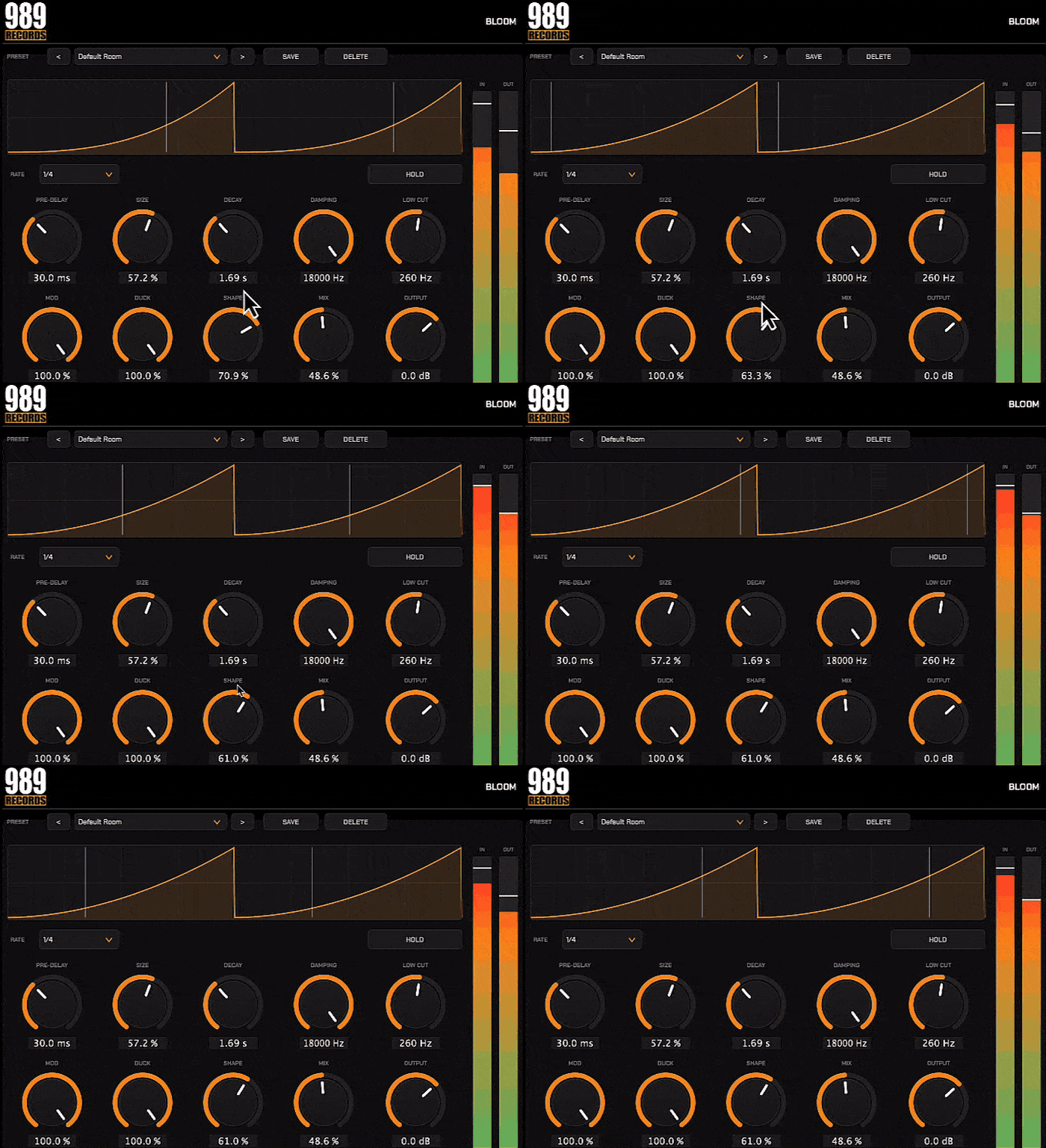 The breathing displayTwo cycles of the ducking movement that Duck and Shape produce together. The top is the tail at full level, the bottom is silence, and a line travels across in time with the transport.RateHow often the ducking happens, in musical time. 1/4 follows a four-to-the-floor kick, 1/2 and 1 bar give slow swells under breakdowns.HOLDPress and hold it and the reverb closes in on itself: the input stops feeding it and whatever was in the tail at that moment stays there, unchanged, until you let go.Pre-delayHow long the reverb waits before it starts. A short gap keeps the dry sound clear and makes the space feel bigger. 20 to 40 ms suits most material.SizeThe dimensions of the space. Low values give a tight room with fast, close reflections, high values a hall where the reflections arrive further apart.DecayHow long the tail takes to die away, measured in the mid range, from 0.2 to 12 seconds. The top end always fades sooner: that is what Damping is for.DampingHow quickly the high end disappears from the tail. Lower settings give a darker, older-sounding room. It changes the colour, not the length.Low CutRemoves low end from what feeds the reverb, so the tail never muddies the bass. On a busy track 200 to 300 Hz is normal.ModSlowly moves the reflections around. A little keeps the tail alive instead of static, a lot adds a gentle chorusing to long decays.DuckHow far the tail drops on every beat. At 0 the reverb is completely still, at 100 it disappears on the beat and swells back. This is the whole point of the plug-in.ShapeHow the tail comes back after each dip. Low values snap back straight away, high values hold it down and swell late. The display shows the result as you turn it.MixBalance between dry and reverb. On an aux send leave it at 100%, on an insert 20 to 35% is usually plenty.OutputFinal level, from minus 24 to plus 12 dB, after everything else.Input and output levelThe two meters show what goes in and what comes out, so you can see how much the ducking is taking off the tail.
Hover any control to read what it doesTap any control to read what it does
Reverb that breathes with the groove
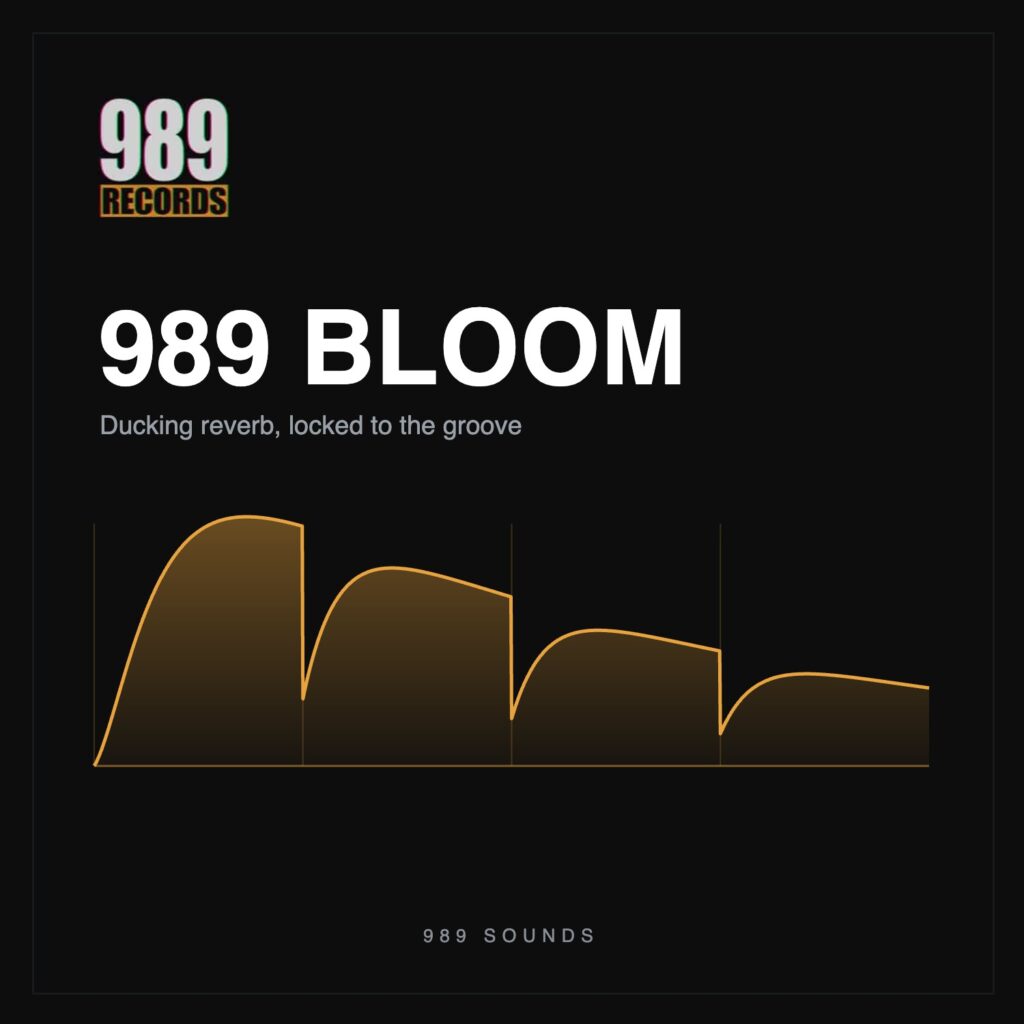
989 Bloom is an algorithmic reverb with ducking locked to your project tempo. The tail steps back on every beat and blooms again in the gap, so the mix stays open and the space is still there. No sidechain routing to set up: the plug-in follows the tempo of the project.
What you turn
- Pre-delay and Size — how far away the room starts and how big it is
- Decay and Damping — how long the tail runs and how dark it gets as it goes
- Low Cut — keeps the bottom end of the mix clear of the tail
- Duck and Rate — how far the tail steps back, and on which beat division
- Shape — how sharply it ducks and how it comes back
- Mod — movement inside the tail, so it never sits still
- HOLD — press it and the tail freezes for as long as you hold it
- Mix and Output — blend it back in and match the level
Get the most out of it
989 Bloom sounds its best on an aux send with Mix at 100%, the way you would use a hardware reverb. Send what you want in the room, keep the dry signal untouched, and let the ducking do the rest.
What you download
- macOS installer — VST3, Audio Unit and standalone app, Apple Silicon and Intel, signed with our Developer ID and notarised by Apple
- Windows installer — VST3, 64-bit
- User manual, eleven sections, with install and uninstall instructions
- Uninstaller included on both systems
Your licence
One licence for you, activated online on up to three machines. Move to a new computer whenever you like: sign in to your account area on this site and release the seat there. Your keys and your machines are always visible in the same place.
Get 989 Bloom
Not on sale yet. It opens soon.
Tell me when 989 Bloom goes on sale
One short email when this gets an update or when something close to it comes out. Nothing else, and you can leave with one click.
| Play | Cover | Release Label |
Track Title Track Authors |
|---|